

What Is Marma Therapy? The Points Ayurveda Reads Like Switches
A trained pair of hands rarely moves at one constant speed, and the places where it slows down are not random.
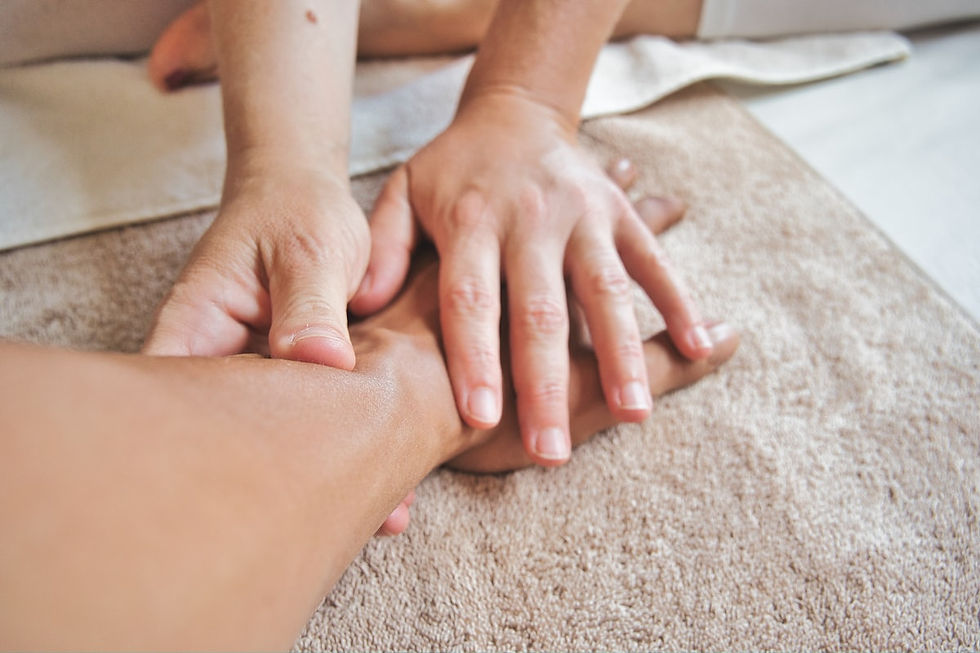
Anyone who has had a full body oil massage here has felt this without necessarily being told what it was. The stroke covers a stretch of shoulder or forearm at a steady pace, then it arrives somewhere specific, and it holds. A beat longer than the skin around it. Then it moves on. That pause has a name in Ayurveda, the traditional medical system that developed on the Indian subcontinent, and it is called marma.
The short version
The short version, if you want the shape of it before the detail.
Marma points are specific spots where classical Ayurvedic texts describe several types of tissue meeting close together: muscle, vessel, ligament, bone, and joint.
Marma is the framework underneath abhyanga, our warm oil massage. It is why a therapist's hands slow down or hold at certain points instead of moving at one even pace.
Classical texts, including the Sushruta Samhita, describe 107 marma points across the body. That number comes from the texts themselves, not from a claim we are making.
Marma work sits alongside greeva basti and our other warm oil sessions rather than replacing them. It is a way of paying attention, not a separate offering on its own.
You can notice a few of these points yourself, without training. The temple and the center of the chest are the easiest places to start.
What marma actually means, in plain English
Marma, a Sanskrit word usually translated as vital point, names a location on the body where classical Ayurvedic texts say several structures sit unusually close together. The Sushruta Samhita, one of the foundational surgical texts of classical Ayurveda, describes a marma as a point where muscle, vessel, ligament, bone, and joint converge, layered close enough that pressure applied precisely lands differently than pressure an inch to either side. That precision is the entire idea behind the word.
This is a map of the body, not a mood. Every point has a location, and classical texts are specific about where. A therapist working with this framework is not improvising when the hands slow near the collarbone or the base of the skull. They are, in the most literal sense, checking a coordinate.
A marma point is not a general zone you rub for a while and call it done.
Why abhyanga lingers exactly where it does
If you have had abhyanga, our most requested full body warm oil massage, you have already met marma work, whether or not the word came up during your session. A therapist trained in this framework does not approach the body as one undifferentiated surface to be covered evenly. The oil goes on everywhere, the strokes are long and continuous, but certain points along that route get more time than the rest.
I think this is part of what separates a session that feels considered from one that just feels like generic rubbing, and it connects to something we have written about before: the idea that massage here is approached with real intention rather than as an indulgence tacked onto a spa menu. Marma is one concrete reason why. The pause at a given point is not the therapist losing the rhythm of the stroke. It is the point.
Honestly, not every client asks about this, and plenty leave a session having felt something shift in attention without ever wanting the anatomy lesson, and that is completely fine. The framework does its work whether or not it gets explained out loud.
The classical map: how many points, and where they sit
This is where I want to be careful, because it is easy to turn an old text into a modern sounding statistic without meaning to. The Sushruta Samhita and later classical commentaries describe 107 marma points distributed across the body. That figure belongs to the text, not to a claim about verified anatomy, and different classical sources group and count them slightly differently depending on the commentary tradition being followed. We repeat the number because it is genuinely part of the history, not because we are asserting it as settled fact.
What the texts agree on more consistently is the general distribution: points cluster around the head and neck, the chest, the joints, and the limbs, roughly in proportion to how much tissue and structure sit close together in each region.
1. Head and neck marma
The temple, the crown, and the base of the skull carry some of the most detailed classical descriptions. This is also where hands slow down noticeably during a session, and where greeva basti, our warm oil therapy for the neck and shoulders, spends most of its time working within the same general region.
2. Chest and sternum marma
The center of the chest, near the sternum, is home to a point classical texts describe with particular care, given how much sits close together in that area. Sessions here are slow by design, with broad, unhurried contact rather than anything sharp or probing.
3. Limb and joint marma
Elbows, knees, wrists, and ankles each carry marma points near the joint itself, which lines up with something anyone who has had bodywork already knows instinctively: joints hold tension differently than the long muscles around them, and they ask for a different kind of attention.

Where you actually feel this in a session
In practice, marma work rarely announces itself. It shows up as a change in pace rather than a change in technique. Oiled hands that had been moving in long strokes down the forearm slow, settle, and hold for a moment at the wrist before continuing. The same thing happens at the base of the skull, at the sternum, at the inside of the elbow. Pay attention to where the pressure holds rather than where it moves fastest, and the map starts to reveal itself even without anyone naming a single point out loud.
Our rooms are kept simple on purpose for exactly this reason. No screens, no background noise competing for attention, just a table, warm oil, and enough quiet that a held point actually registers instead of getting lost in everything else going on in the room.
What marma therapy is not
I want to say this plainly, because it matters more than it sounds like it should. Marma work, as we practice it, is a traditional framework for attention and technique within a warm oil massage. It is not a diagnostic system, it is not a substitute for seeing a doctor about a specific concern, and we do not present it as clinically verified in the way modern medicine verifies a procedure. Classical Ayurvedic texts describe marma in their own terms, developed over a long and specific history, and we think that history is worth knowing on its own terms rather than dressing it up as something it was never meant to be.
If you are pregnant, recovering from a recent injury, or already under a doctor's care for something specific, mention that when you book, the same way you would before any full body session. None of this is complicated, it is just basic care taken seriously.
Noticing it for yourself
You do not need a table or an appointment to feel a version of this. Rest two fingers lightly at your temple for a slow count of ten, then do the same at the center of your chest, just above the sternum. Most people notice these two spots feel different from the skin around them, quieter somehow, without being able to say exactly why. Classical Ayurveda simply took the trouble to map that difference and give it a name.
That difference in quality is the whole premise marma starts from.
We did not invent this framework, and I do not think we could improve on centuries of careful observation if we tried. What we can do is bring the same attention to it that the texts describe, one point at a time, in a room quiet enough for it to actually register.


Comments